What Is ITIL?
ITIL (Information Technology Infrastructure Library) is a globally recognized framework of best practices for IT Service Management (ITSM).
Its primary objective is to align IT services with business goals, enhance service quality, and ensure sustainable operational efficiency.
It is crucial to note that:
ITIL is not a software.
ITIL is not a rigid standard.
ITIL is a management framework.
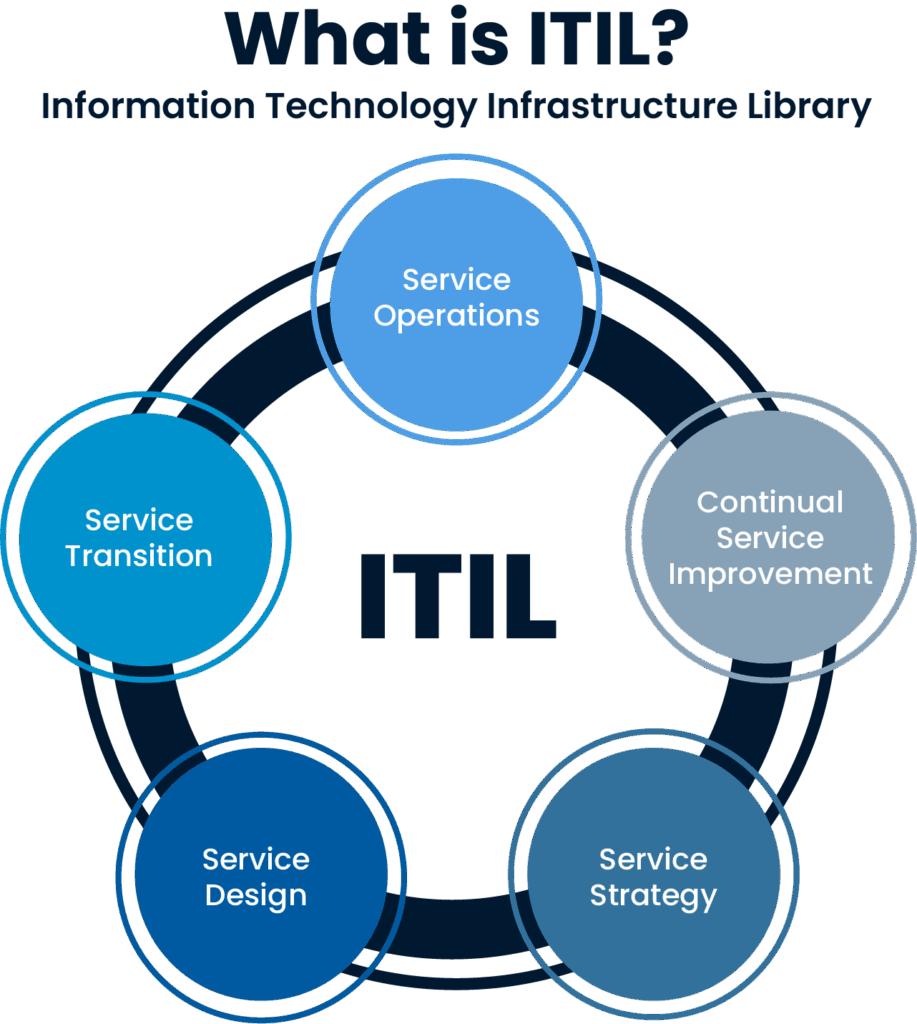
It provides a systematic approach to the following stages of IT services:
Planning
Design
Transition (or Deployment)
Operation
Continual Improvement
What Is ITSM?
ITSM (IT Service Management) is the discipline of planning, delivering, managing, and improving IT services.
In short:
IT Service Management (ITSM) = The management approach
Information Technology Infrastructure Library (ITIL) = The framework used to implement this approach
What is the Difference Between ITIL and ITSM?
| ITIL | ITSM |
|---|---|
| A framework of best practices | A management approach |
| Describes how to do things | Defines what needs to be done |
| Provides guidance and recommendations | Covers operational implementation |
| Defines processes and practices | Encompasses overall service management |
The Core of ITIL: Continual Improvement (PDCA Cycle)
The Information Technology Infrastructure approach is built upon quality management principles. Plan → Do → Check → Act (PDCA) This cycle ensures that:
Service performance is measured.
KPIs and SLAs are monitored.
Processes are regularly optimized.
This structure transforms IT teams from a reactive stance to a proactive powerhouse.
“In today’s world where digital transformation is rapidly taking shape, ITIL 4 offers a powerful roadmap for businesses. To examine the benefits of ITIL 4 for businesses in more detail, check out our article titled What is ITIL 4? “Benefits for Businesses!“
The Evolution and Versions of the IT Infrastructure Library
ITIL v1 (1989)
Introduced a structured approach to IT service management.
ITIL v2 (2000)
Standardized key operational processes such as:
Incident Management
Problem Management
Change Management
ITIL v3 (2007)
Introduced the Service Lifecycle approach, consisting of five core stages:
Service Strategy
Service Design
Service Transition
Service Operation
Continual Service Improvement
ITIL 4 (2019)
Updated to address the needs of modern digital transformation.
ITIL 4:
Aligns with DevOps practices
Integrates with Agile methodologies
Supports Lean principles
Is compatible with cloud and microservices architectures
Is built around the Service Value System (SVS)
The Evolution and Versions of the IT Infrastructure Library
The Service Value System (SVS) ensures that all components of an organization work in a coordinated manner to co-create value. It consists of 5 core components:
Guiding Principles
Governance
Service Value Chain
Practices
Continual Improvement
This structure has transformed the Information Technology Infrastructure approach from being purely process-centricto being value-centric.
ITIL 4 Management Practices
In the ITIL (Information Technology Infrastructure Library) approach, the term “Practice” is used instead of “process.”
1️⃣ General Management Practices
Risk Management
Project Management
Information Security Management
Continual Improvement
2️⃣ Service Management Practices
Service Desk
Incident Management
Problem Management
Change Enablement
Service Level Management (SLM)
IT Asset Management (ITAM)
3️⃣ Technical Management Practices
Software Development and Management
Infrastructure and Platform Management
Deployment Management (Altyapı operasyonlarını kapsayan teknik terim)
Key Business Benefits of Adopting ITIL 4
Increased Efficiency
Standard processes reduce operational complexity.
Cost Savings
Repetitive tasks can be managed with automation.
Better Visibility and Traceability
SLA (Service Level Agreement) tracking and measurable performance improvement are provided.
Faster Response Times
IT is no longer a support unit, but a strategic business partner.
Continuous Improvement
Data-driven decision-making structures evolve.
Why Is It Critical In Digital Transformation?
Digital transformation transcends simple technology investments—it demands process maturity. > The ITIL framework:
Standardizes core processes to eliminate inconsistency.
Architects the foundation for advanced automation.
Synergizes with low-code and AI-driven ITSM platforms.
Builds a scalable operational framework for growth.
True value is unlocked only when ITIL principles are powered by modern ITSM solutions.
Conclusion
IT Infrastructure Library exists not to control IT services, but to generate value.
If you have an ITSM strategy, Information Technology Infrastructure systematizes this strategy. Information Technology Infrastructure 4 enables you to do this in a way that meets the needs of the digital age.
Frequently Asked Questions (FAQ)
Is the ITIL Certification Difficult?
The ITIL (Information Technology Infrastructure Library) certification is not considered difficult, as it measures conceptual, process, and strategic knowledge rather than deep technical expertise. In particular, the IT Infrastructure Library 4 Foundation level is highly accessible for IT managers, service managers, and process owners. Professionals with experience in IT operations can easily obtain the certification with basic preparation.
What is the Difference Between ITIL 4 and ITIL v3?
While ITIL v3 focused on processes and the service lifecycle, ITIL 4 focuses on value and flexibility. Key Differences:
v3 → Process-centric structure.
4 → Service Value System (SVS) and value chain approach.
4 is fully compatible with Agile, DevOps, Lean, automation, and cloud infrastructures.
The concept of “Practice” is used instead of “process.”
In short, IT Infrastructure Library 4 has been redesigned to meet the demands of the digital transformation era.
Is IT Infrastructure Library a Software?
No. Information Technology Infrastructure Library is not a software. It is a comprehensive guide of best practices and processes developed for IT Service Management (ITSM). While IT Infrastructure Library principles are implemented through ITSM software, low-code platforms, and automation tools, IT Infrastructure Library itself is not a product.
Which Sectors Use ITIL?
IT Infrastructure Library is not limited to tech companies; it is utilized across all sectors that provide or depend on IT services. The most common application areas include:
Finance and Banking
Telecommunications
Government and e-Government Services
Healthcare
Retail and E-commerce
Manufacturing and Logistics
Energy and Infrastructure
Wherever continuity, quality, and measurability of IT services are essential, ITIL can be implemented.