What Is Digital Business Processes?
Digital business processes represent a modern approach that enables organizations to manage and continuously improve their operational activities through end-to-end technology. It replaces manual, fragmented, and error-prone workflows with data-driven, traceable, and automation-based processes.
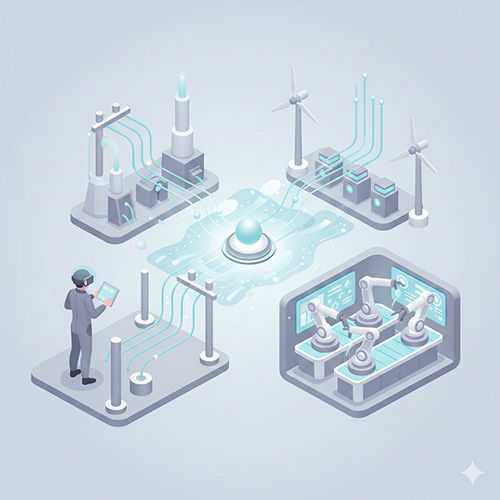
Spanning a wide range of areas—from field operations and production lines to energy management and support services—digital business processes provide organizations with speed, transparency, and operational efficiency.
With well-structured digital business processes, companies can reduce costs, accelerate decision-making, and adapt more flexibly to evolving business requirements.
Why Have Digital Business Processes Become So Critical in 2026?
As of 2026, the true competitive advantage for organizations is no longer just owning technology, but how fast, flexible, and measurable they can manage their business processes. Today, it is not the companies with the “best software” that survive, but those that can “transform their data into the fastest workflows.” Especially in operationally intensive sectors such as field services, energy, and manufacturing, digital business processes:
Enable real-time decision-making.
Reduce operational risks.
Minimize human dependency.
Guarantee service continuity.
The 10 minutes spent by a field technician filling out a manual form is no longer an acceptable loss at the speed of 2026. In these sectors, if digital processes remain manual or fragmented, growth inevitably leads to a loss of control.
Let’s evaluate a digital process roadmap tailored to your organization.
Get a Free Assessment2026 Digital Business Process Trends
Before diving into specific sectors, it is essential to clarify the core technological approaches shaping 2026. We no longer use technology simply to “record” our work, but to “manage” it.
AI-Powered Process Orchestration
In 2026, digital business processes are no longer just “flows”; they are structures that predict, suggest, and take action. Artificial intelligence no longer merely presents a report at the end of a process; it functions as a “decision partner” within the process itself.
Potential delays are predicted in advance (using data such as weather, traffic, parts supply, etc.).
Priorities change dynamically based on process intensity.
SLA (Service Level Agreement) violations are intervened in before they occur.
Continuous Evolution of Processes with Low-Code
In sectors such as field services, energy, and manufacturing, processes are not static. In a world changing this rapidly, waiting three months for a software team to update a process is no longer a sustainable model. Thanks to the low-code digitalization approach:
Processes are updated in days, not weeks.
Business units (the engineer in the field, the supervisor in the factory) participate more actively in the process.
Digital transformation ceases to be a “one-time project” and becomes a living part of the organization.
Real-Time Visibility and Data-Driven Management
In 2026, retrospective reports are merely “historical” data. Today’s manager does not want to drive a car by looking only at the rearview mirror.
Instead of “What happened yesterday?”, the question “What is happening right now and what will happen in 2 hours?” is answered.
Through real-time KPI tracking and live operational dashboards, bottlenecks are identified before they even occur.
Digital Business Processes in Field Operations
Field operations are where digitalization begins not “on paper,” but “beneath dusty boots.” When not digitalized:
Work orders are delivered late, and teams are prioritized incorrectly.
Operational blindness sets in when it is unknown which team is where or what spare parts they carry.
Response times increase, and customer satisfaction declines.
In 2026, digital business processes for field operations must be proactive rather than reactive. We no longer wait for a breakdown to occur; the system warns us of the risk of failure and directs the nearest team to the location.
How Do Digitalized Field Processes Work?
Automated Requests: Demands are automatically converted into work orders.
Skill-Based Assignment: The system assigns not just the “nearest team,” but the “nearest team with the right expertise and the required spare parts in hand.”
Real-Time Mobilization: Mobile teams are notified instantly, and field data (photos, videos, digital signatures) flows immediately into the system.
Digital Business Processes in Energy
The energy sector is an area with one of the lowest margins for error. Here, digital transformation is not just a matter of efficiency; it is a matter of public safety and system stability.
The cost of outages is high, not only financially but also in terms of prestige and regulation.
In 2026, digital processes in the energy sector are a strategic necessity.
Core Digitalized Processes in the Energy Sector
Predictive Maintenance: Transforming data from sensors into actionable workflows.
Outage Management: When a transformer fails, the system isolates the affected area and automatically dispatches teams.
Compliance and Regulatory Reporting: Eliminating manual errors from the reporting process.
Digital Business Processes in Manufacturing
In production, time is quite literally money. “Downtime” is a manufacturer’s nightmare in the competitive landscape of 2026. In organizations lacking digital business processes, data is usually entered into the system at the end of a shift—meaning after it is already too late.
The Role of Digital Business Processes in Manufacturing in 2026
Asset-Based Processes: Every machine reports its own health status and autonomously generates its own maintenance requests.
Real-Time KPI Tracking: While production KPIs are monitored instantly, the system automatically alerts management the moment a deviation occurs.This signifies not just “producing fast,” but “producing continuously.”
Most Common Mistakes in Digital Business Processes
Despite the technology of 2026, those who fail share these common pitfalls:
Digitalizing Chaos: Moving a poorly structured, cumbersome process to a digital environment only ensures that you “make mistakes faster.”
Ignoring User Experience: Complex interfaces that field personnel cannot use lead to the system being bypassed.
Collecting Data Without Analysis: Gathering data is not an achievement; it is only the beginning.
A Clear Message for 2026 Digital Transformation
In the field services, energy, and manufacturing sectors, digital business processes are no longer a luxury; they are a condition for operational survival. A well-structured framework increases speed, minimizes human error, and makes the organization resilient against an uncertain future. If your processes are not digital, you are not actually managing your business; you are merely watching what happens.