What Is Business Software Integration?
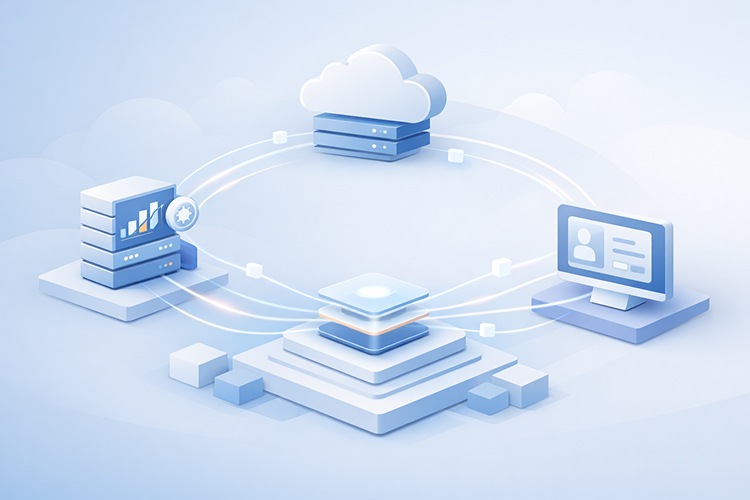
Business software integration is the framework that enables disparate internal systems—such as ERP, CRM, HR, Finance, and field applications—to share data consistently, securely, and automatically.
On paper, everything looks simple. In practice, however:
Changes in one system fail to sync with others,
Data inconsistencies emerge,
Manual workloads increase,
Operations slow down.
At this stage, system integration errors directly jeopardize all digital workflows and investments.
Get in Touch
Why Business Integration Projects Fail?
1. Viewing Integration as a "Side Task"
In many organizations, integration is only addressed at the very end of the software procurement process. First, the product is selected, and then it is assumed that “we can just connect it to other systems later.”
This approach:
Accumulates technical debt throughout the software implementation process,
Leads to cost overruns due to retrofitted integrations,
Causes significant delays in project timelines.
Business Software Integration projects are not just IT details; they are a matter of business continuity.
2. Why Digital Transformation Stalls Without Flexible Integration Architectures
Rigid, point-to-point integrations may seem fast initially. However, as the number of systems increases, this structure becomes unmanageable.
In environments lacking flexible integration architectures:
Every new integration risks breaking the existing system,
Changes trigger a chain reaction of errors,
Digital transformation projects fail to scale.
Consequently, many digital transformation failures stem from poor decisions made at the architectural level.
3. Data Integration Problems are Being Overlooked
One of the most frequent challenges we encounter is data integration problems. Examples include:
The same customer having conflicting records in ERP and CRM systems,
Financial data appearing inconsistent across different reports,
Attempting to meet real-time data needs using outdated batch processing structures.
This situation not only hinders operations but also renders ROI (Return on Investment) analysis results meaningless.
4. ERP Integration is More Difficult Than Expected
In particular, ERP (Enterprise Resource Planning) integration is one of the most challenging areas for organizations. This is due to ERP systems having:
Highly complex data models,
High levels of customization,
Frequent API limitations.
Poorly structured ERP integrations can bring an entire project to a standstill.
5. API Incompatibilities and Technical Debt
Even though modern software appears to offer APIs, in practice:
Version mismatches,
Lack of documentation,
And security constraints…
…make API incompatibilities the silent killer of integration projects. If project management risks are not accurately analyzed at this stage, the project can easily sink into a quagmire of technical debt.
Evaluating Integration Options: A Guide for Software Buyers
When purchasing business process software, looking solely at the feature list is a major mistake. The critical questions that must be asked are:
What are the integration options when purchasing business process software?
Does it offer standard API support?
Is real-time data streaming possible?
Does it support event-driven integrations?
Can it be easily scaled with different systems?
The answers to these questions directly impact future cost overruns and the need for redevelopment.
The value of a Low-Code integration approach in the enterprise
In recent years, low-code integration approaches have been providing a fresh perspective to integration projects. Traditional code-heavy integrations can no longer keep pace with the speed of business. While low-code integrationreduces development times by up to 40%, it also significantly lightens the load on IT teams. The reason we prefer flexible, low-code supported integration architectures in our projects is to offer organizations a traceable structure with a minimal margin for error.
The core advantages of Low-Code integration include:
Substantially shorter development cycles,
Reduced workload for IT teams,
Rapid adaptation to changing business needs,
Highly visible and manageable integrations.
The critical point is this: While low-code may not solve every problem on its own, when combined with the right integration architecture, it provides organizations with significant agility.
Complete your integration projects in days, not weeks. Discover the Cheetah Low-Code Platform with its flexible integration architecture!
Actionable Solution Approaches for Successful Integration Projects
Design Integration from the Ground Up Define your integration scenarios during the software selection phase.
Build a Scalable Architecture Think about where you will be in three years, not just where you are today.
Center on Data Quality Without data consistency, digital transformation is merely an illusion.
Bring Business and IT Teams to the Same Table Integration is not just a technical matter; it is a business-oriented priority.
Conclusion: No Digital Transformation Without Integration
In summary, business software integration projects act either as an accelerating force in an organization’s digital transformation journey or as an invisible barrier that drags down the entire investment.
Failed integration projects typically arise due to:
Poor architectural choices,
Inadequate integration options,
Failure to address data and processes as a unified whole.
With correctly structured, flexible integration architectures and modern approaches, integration projects are no longer a risk—they can transform into a strategic competitive advantage.