What is Text Anonymization?
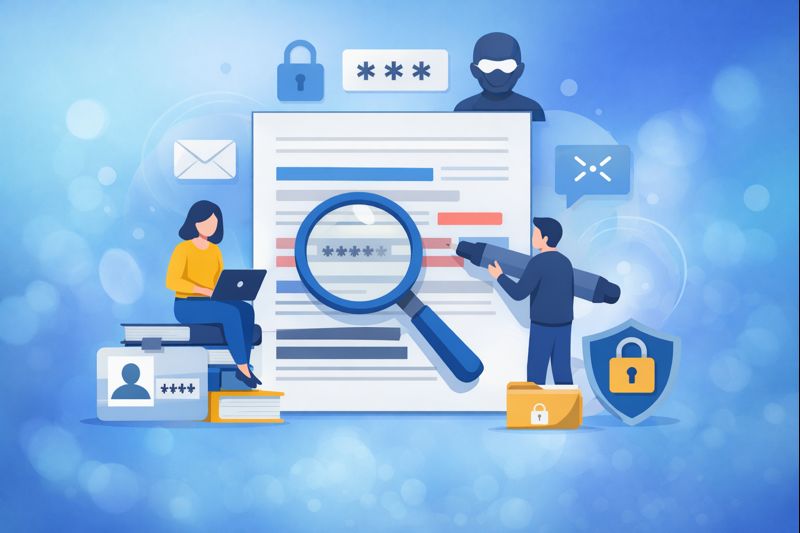
Text anonymization is the automated process of detecting and masking Personally Identifiable Information (PII) and sensitive data within raw text to prevent a potential data breaches.
This process ensures that data can be shared and analyzed securely without exposing individual identities. Far more than just deleting characters, text anonymization is a sophisticated data protection step that neutralizes data breaches risks while preserving the operational value of your information.
Why is Text Anonymization Critical?
Digital Transformation and the Surge in Data
Modern organizations process massive volumes of text data, ranging from customer feedback and support chats to internal reports and legal contracts.
These documents often contain direct or indirect identifiers. When this sensitive content is exposed, it creates a massive data breaches risk, leading to severe reputational damage and costly legal liabilities.
Regulations: Ensuring GDPR and HIPAA Compliance
Strict regulations such as GDPR (General Data Protection Regulation) and HIPAA (Health Insurance Portability and Accountability Act) mandate the protection of personal data. In this context, text anonymization is not just a security measure—it is a fundamental requirement for privacy compliance.
By implementing these standards, organizations can effectively prevent a data breaches and avoid the heavy fines associated with regulatory non-compliance.
How Does Text Anonymization Work?
The text anonymization process involves several technical layers and advanced technologies to ensure data integrity:
1. Data Detection & Identification
AI-powered models and Natural Language Processing (NLP) techniques are used to detect PII and sensitive information within the text. In this stage, machine learning (ML) and contextual understanding play a critical role.
For instance, a sophisticated system must distinguish whether “Jordan” refers to a person’s name or a geographical location to ensure accurate protection.
2. Masking & Redaction
Data Masking: Sensitive information is hidden using characters or symbols (e.g., [PII] or ****).
Document Redaction: A dedicated document redaction tool blacks out or removes sensitive phrases directly from the file.
These processes prevent identity exposure while preserving as much data usability as possible. By securing the content at this stage, organizations can share internal documents without the fear of an accidental data breaches.
3. Pseudonymization
Some systems replace personal identifiers with meaningless yet consistent values that remain functional for analysis. This method is particularly vital for AI and Machine Learning applications.
By using pseudonymization, companies can train models on realistic datasets without risking a data breaches, ensuring that sensitive information remains decoupled from individual identities while maintaining analytical integrity.
Benefits of Text Anonymization to Stop Data Breaches
🔐 Smart Protection for Personal Data
Anonymization prevents the exposure of PII, ensuring that user privacy is protected while minimizing data security risks. This is particularly critical for enterprise data warehouses, where the volume of information increases the potential impact of a data breaches.
By implementing smart protection, organizations can safeguard their most valuable assets without hindering data accessibility.
📊 Uninterrupted Insights and Analytics
Anonymized datasets remain fully functional for data science, reporting, and training AI models. This allows organizations to maintain their analytical capabilities and derive valuable insights without compromising security.
By ensuring that data remains useful yet safe, businesses can continue their data-driven decision-making processes while effectively eliminating the risk of a data breach.
📜 Meeting Compliance Requirements
Identity obfuscation processes aligned with regulations like GDPR and HIPAA simplify legal compliance reporting and prevent potential administrative fines.
Beyond mere documentation, these processes act as a vital safety net; in the event of a data breach investigation, having robust anonymization in place proves that your organization has taken proactive steps to protect sensitive information.
Text Anonymization in Practice: A Step-by-Step Guide
The following steps systematize the text anonymization process for seamless integration:
1. Identify the Data Source
Where is your text data coming from? Whether it is CRM records, support chats, legal documents, or other internal systems—each source has a unique structure. Identifying these sources is the first step in creating a robust defense against a potential data breach.
2. Choose the Anonymization Model
The selection of the right model depends on your specific workload and risk profile. Common approaches include:
Rule-Based Filters: Basic GLiNER or Regex-based patterns for predictable data.
NLP / AI-Powered Models: Advanced machine learning for contextual and unstructured text.
Specialized Text Anonymization Software: Purpose-built platforms designed for high-scale security.
The choice you make here is the primary factor in determining how effectively you can prevent a data breach within your specific operational environment.
3. Test & Implementation
Run your chosen solution against your actual datasets to evaluate the quality of the masking. During this phase, it is essential to detect any false positives (incorrectly flagged data) or false negatives (missed PII).
A thorough evaluation ensures that your data breach prevention strategy is both accurate and reliable before full-scale deployment.
4. Auditing & Continuous Monitoring
How effective is your anonymization system? Since data patterns evolve and AI models can degrade over time, regularly measuring performance is critical.
Continuous auditing ensures that your defense against a data breach remains impenetrable, allowing you to update your models and maintain high-security standards as your data grows.
How Does SPIDYA AI-Powered Data Anonymization Work?
Let’s introduce the SPIDYA Data Anonymization Tool, a powerful solution designed to simplify enterprise-level text anonymization processes:
🔎 Try the Next-Generation Data Anonymization Tool of 2026 for Free!
✅ Use Cases
Internal Reports & Documents: Secure sharing across departments.
Customer Support Chats: Protecting privacy in service logs.
Analytical Data Lakes: Safe big data processing.
AI Training Datasets: High-quality data for machine learning without risks.
🧠 Key Features
Automated PII Detection: Instant identification of sensitive entities.
Advanced Masking & Redaction: Industry-leading Document Redaction Tool capabilities.
AI-Powered Precision: Context-aware anonymization that understands the difference between a name and a common noun.
Regulatory Alignment: Built-in compliance for GDPR, HIPAA, and KVKK.
📌 How It Works: Step-by-Step
Upload or Paste: Simply input your text or document into the interface.
AI Analysis: The system scans for Personally Identifiable Information (PII) in real-time.
Instant Anonymization: Automatically mask or redact sensitive data with one click.
Secure Sharing: Your anonymized content is ready—download and share with total confidence!
The SPIDYA Data Anonymization Tool helps organizations minimize the risk of a data breach while maintaining the speed of insight generation. By balancing ironclad security with data utility, SPIDYA ensures your business stays compliant, secure, and data-driven in the face of evolving digital threats.
| Feature | Traditional Methods | SPIDYA & AI-Powered Data Anonymization Tool |
|---|---|---|
| Speed | Manual / Slow | Within Seconds |
| Context Awareness | None (Keyword Matching Only) | High (NLP-Powered) |
| Error Rate | High (Easy to Miss) | Minimal (AI-Controlled) |
| Regulatory Compliance | Risky | Full (KVKK / GDPR / HIPAA) |
Text Anonymization FAQ
Can Anonymized Data Be Reversed?
True anonymization is a one-way process and is irreversible. Once data is fully anonymized, the link between the information and the individual is permanently severed.
If your workflow requires the ability to re-identify the data at a later stage, Pseudonymization (the use of artificial identifiers) should be preferred instead. While anonymization offers the ultimate protection against a data breach, pseudonymization allows for data re-identification under strictly controlled conditions.
What is the Difference Between Data Masking and Anonymization?
The primary difference lies in the level of concealment and the goal of the process. Data Masking is typically used to hide specific parts of a data string (e.g., masking a credit card number except for the last four digits) to allow for partial visibility. In contrast, Anonymization goes a step further by making it mathematically and technically impossible to associate the data with an individual. While masking protects data during viewing, anonymization fundamentally alters the record to prevent any future data breach involving personal identities.
Conclusion: Minimize Data Risks with Text Anonymization
Text anonymization is more than just a technical step; it is the security and compliance backbone of your entire data strategy. Implementing smart anonymization for personal data ensures that your organization builds a more secure, scalable, and compliant data infrastructure.
👉 Eliminating risks in seconds while maintaining the continuity of data production and analysis is no longer just an option—it is a business necessity. By adopting these measures today, you are not just protecting records; you are fortifying your brand against the long-term consequences of a potential data breaches.