
Digital transformation is no longer just a technology investment; it is a strategic transformation process designed with the goal of customer experience-driven improvement. While many organizations launch digitalization projects, they often fail to achieve the expected business results. The primary reason for this is that the digital transformation strategy is structured in isolation from the customer experience.
In this article, we explore how to design a digital transformation strategy that puts customer experience at the center, which problems it solves, and the tangible business benefits it delivers.”
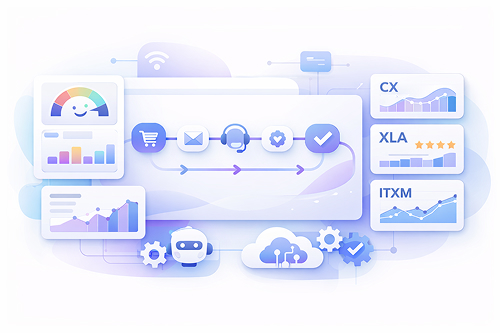
What is Customer Experience-Driven Digital Transformation?
Customer experience-driven digital transformation is a strategic approach where an organization redesigns every digitalization step based on customer needs, expectations, and touchpoints.
In this approach, the objective is:
Not simply to use more technology,
But to deliver a superior, consistent, and measurable customer experience (CX).
In short: Technology is the vehicle; CX is the destination.
Therefore, successful digital transformation projects evaluate the dimensions of process, technology, and people through a (CX) perspective.
Why is Customer Experience Critical in Digital Transformation?
Many digital transformation projects face the following challenges:
Investment was made, but customer satisfaction did not increase.
Processes were digitized, but the experience became more complex.
IT is successful, but the business side is not satisfied.
The reason for this is that the transformation is designed with an internal process-oriented focus.
What Does a Customer Experience-Driven Approach Deliver?
Reduces friction at customer touchpoints.
Makes service quality measurable.
Strengthens loyalty, retention, and brand perception.
Ensures digital investments translate into tangible business outcomes.
In customer experience–driven digital transformation projects, the right measurement and automation approach plays a critical role. We can help you assess your digital transformation processes and create a roadmap tailored to your organization.
Fill Out the Form Now!How to Build a Customer Experience-Driven Digital Transformation Strategy?
A successful strategy begins with asking the right questions before choosing the technology.
1. Understanding the Current Customer Experience (Customer Journey Analysis)
The first step is to clarify all the touchpoints where the customer interacts with the organization:
Request creation
Service delivery
Support processes
Feedback and complaint management
At this stage, answers to the following questions are sought:
Where does the customer face the most friction?
Which steps are causing time loss?
Which processes are manual and prone to error?
This analysis indicates exactly where digital transformation processes should begin.
2. Clarifying Experience Goals (CX KPIs)
Simply saying “the CX has improved” is not enough. Improvement must be measurable. At this point, the following metrics come into play:
Response time
Request resolution time
First contact resolution rate
Satisfaction scores (CSAT/NPS)
Service consistency
At this stage, the classic SLA (Service Level Agreement) approach falls short. This is because an SLA measures the process—not the customer’s perception.
Where Do ITXM and XLA Fit Into This Picture?
What Is IT Experience Management (ITXM) ?
ITXM (IT Experience Management) is an approach that aims to measure not only the technical performance of IT services but also the user and customer experience.
In CX driven digital transformation, ITXM:
Enables IT teams to speak the same language as business units.
Links technical success directly to experience success.
Why XLA (Experience Level Agreement) Is Important?
XLA (Experience Level Agreement) goes beyond traditional SLAs and asks the following question:
“How did this service make the customer feel?”
Example:
SLA: The request was resolved in 4 hours.
XLA: Did the user find this process easy, clear, and satisfying?
In customer experience-driven digital transformation strategies:
XLAs make the experience visible.
They foster a culture of continuous improvement.
How AI and Automation Transform the Customer Experience?
Artificial Intelligence and automation are among the most powerful levers of customer experience-driven digital transformation.
Tangible Benefits of AI & Automation
Automated resolution of repetitive requests.
Personalized service experience.
Proactive support (intervention before problems arise).
24/7 uninterrupted service.
For example:
With AI-powered classification, requests are routed to the correct team.
Automation reduces waiting times significantly.
The customer experiences a more transparent and rapid process.
The critical point here is: Artificial Intelligence (AI) creates value only when it is utilized to enhance the CX.
Which Problems Does It Solve?
A customer experience-driven digital transformation strategy solves the following fundamental problems:
Fragmented and disconnected customer journeys
Inconsistent service quality
Unmeasurable satisfaction
Communication gaps between IT and business units
Failure of digital investments to translate into tangible benefits
The Tangible Outcomes of a Successful CX-Driven Digital Transformation
Organizations that adopt this approach typically achieve the following results:
Shorter resolution times
Higher customer satisfaction scores
Increased operational efficiency
More predictable service quality
Higher ROI on digital transformation projects
How to Synchronize Digital Transformation and Customer Experience?
Digital transformation encompasses technology, processes, and people. Customer experience, on the other hand, represents how these three dimensions feel to the end-user.
Successful strategies:
Align digital transformation processes with CX goals.
Measure the experience through ITXM (IT Experience Management) and XLAs.
Use AI and automation to make the experience sustainable and scalable.
If You Cannot Measure Experience in Digital Transformation, You Are Only Pretending to Manage It!
Despite making significant investments in digital transformation, many organizations fail to see the expected improvement in customer experience. The primary reason for this is that the transformation progresses solely with a focus on technology and processes, while the experience itself is not made measurable and manageable.
How SPIDYA Empowers Customer Experience-Driven Digital Transformation?
By placing customer experience at the heart of its ITSM approach, SPIDYA aims to bridge the gap between technology and business expectations. With a framework that makes experience both measurable and manageable, it ensures that digital transformation translates into tangible business outcomes.
1. The XLA Approach: Making Experience Visible
The XLA (Experience Level Agreement) approach reveals not only whether services are technically functional but also the quality of the experience they deliver to the customer. By moving beyond traditional SLAs, organizations can measure customer perception, satisfaction, and experience quality.
2. Unified Goals in ITSM Processes
When IT Service Management (ITSM) processes are integrated with XLA and experience metrics, IT teams and business units align around the same objectives. Consequently, service quality is managed not only from an operational standpoint but also from an experiential perspective.
3. Consistent Experience Through AI and Automation
Thanks to AI and automation-powered ITSM processes, requests are managed more rapidly, consistently, and predictably. While repetitive tasks are automated, friction at customer touchpoints is significantly reduced.
4. Measurable and Sustainable CX Improvement
This approach moves digital transformation away from being an abstract technology investment and turns it into a measurable, traceable, and continuously improving customer experience transformation.
Conclusion
Customer experience-driven digital transformation:
Does not have to be a massive or complex project.
It is enough to start with the processes that have the most touchpoints or the most frequent issues.
Organizations that progress with small steps, accurate measurement, and clear goals move digital transformation beyond being just a technology project and turn it into real business value.