What Is SLO?
A Service Level Objective (SLO) is a measurable performance target that a specific IT service must achieve within a defined timeframe. To answer what is SLO fundamentally: it clarifies how long services should remain accessible, how quickly incidents should be addressed, or the speed at which user requests are expected to be fulfilled.
In short: An SLO defines “when an IT service is considered successful.”
In the world of Agile ITSM, understanding what is SLO is crucial because these objectives transform abstract quality expectations into concrete targets, becoming one of the fundamental building blocks of service management.
What Is the Difference Between SLO, SLI, and SLA?
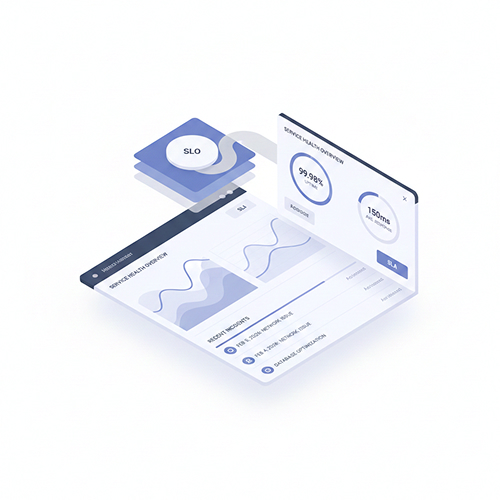
The question “What is SLO?” is often discussed in modern IT operations alongside the concepts of SLI (Service Level Indicator) and SLA. However, each of these terms serves a distinctly different purpose in measuring and managing service quality.
SLI (Service Level Indicator)
They are metrics used to measure service performance.
Average response time
Error rate
Uptime percentage
SLO (Service Level Objective)
It is the target level defined for these metrics.
99.9% availability
Response to critical incidents within 15 minutes
SLA (Service Level Agreement)
It is the contract between the customer and the service provider that includes SLOs. It contains commercial commitments and penalties.
SLI measures, SLO sets the target, and SLA formalizes these targets within a contractual agreement.
Why Does SLO Play a Critical Role in ITSM?
IT Service Management (ITSM) aims to plan, deliver, and continuously improve services end to end. However, in many organizations, ITSM processes still operate reactively.
This is where understanding what is SLO becomes essential.
SLOs provide critical advantages for ITSM:
They make service quality measurable
They establish clear priorities in incident and request management
They create a shared definition of success across teams
Example:
Instead of saying,
“We respond to issues quickly,”
saying,
“95% of critical incidents will receive an initial response within 15 minutes,”
makes ITSM processes both transparent and manageable.
How Is SLO Used in ITSM Processes?
Incident Management
When answering the question What is SLO (Service Level Objective)?, it is important to understand that this concept is not just about fixing failures. The real focus is not only resolving incidents technically, but strategically limiting their impact on business processes within incident management.
Example SLO:
90% of critical incidents will be resolved within 30 minutes
As a result:
Truly critical incidents are properly prioritized
The perception that “everything is urgent” is eliminated
Request Management
User requests are clarified in terms of the time frame within which they must be fulfilled.
Example SLO:
95% of standard requests will be completed within 1 business day.
Problem Management
It ensures a focus on the root cause of recurring issues.
Example SLO: A specific incident type may recur no more than 2 times within 30 days.
💰🔍 Incident Management and SLO Transformation in a Financial Firm
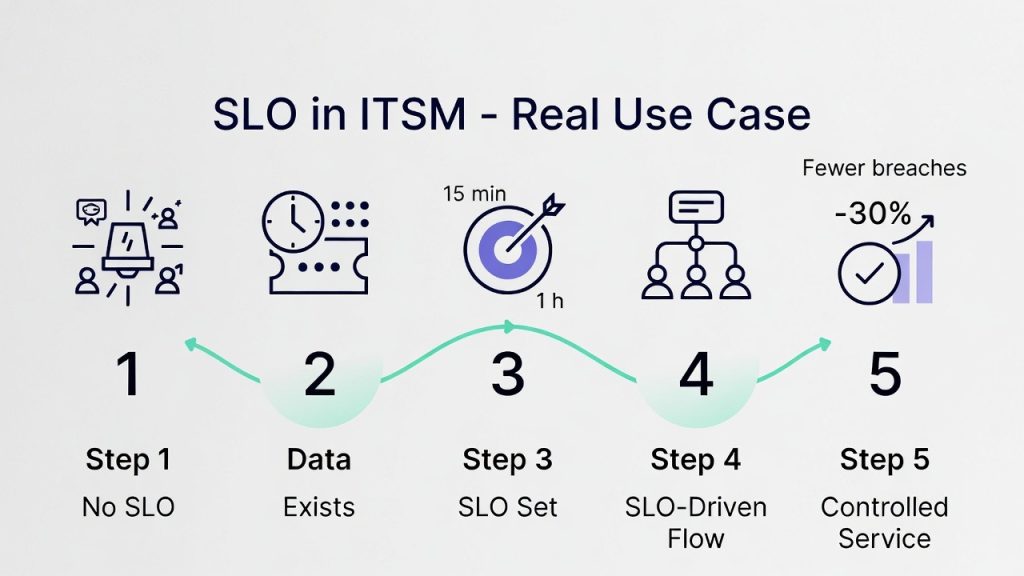
An ITSM team at a mid-sized financial company struggled to measure service quality despite rising user complaints. While SLA (Service Level Agreement) reports were maintained, there was no clear prioritization mechanism for teams during daily operations.
Problems Encountered:
Inability to distinguish between critical and non-critical incidents.
An overwhelming number of tickets opened with “Urgent” labels.
Failure to understand the root causes of SLA violations.
The Action Taken: Clear SLOs were defined for ITSM processes. To understand the practical application of what is SLO, the company established these specific targets:
Initial response to 95% of critical incidents within 15 minutes.
Resolution of 90% of high-priority events within 1 hour.
The Result:
Incident response times improved by 30%.
Teams began to clearly distinguish which tickets were truly critical.
SLA violations decreased measurably.
This example clearly demonstrates that SLOs are not just theoretical targets in ITSM (IT Service Management) processes, but practical tools that guide daily operations.
Common Mistakes When Defining SLOs
1. Setting Unrealistic Goals
A 100% availability target is practically unsustainable and leads to team burnout.
2. Ignoring User Experience
The system may be running, but if the user cannot actually utilize the service, the SLO has effectively failed.
3. Creating Unmeasurable SLOs
Phrases like “providing better service” are not SLOs. An SLO must always be measurable.
Why Data is Crucial for SLO Sustainability
SLOs generate value not just when they are defined, but when they are continuously measured and monitored. This requires operational data such as:
Ticket data
Incident logs
Timestamps
User interactions
However, ITSM data often:
Contains personal information
Involves sensitive business processes
Carries risks regarding sharing and analysis
This causes what is SLO (Service Level Objective) tracking to remain superficial in many organizations.
How SPIDYA ITSM Simplifies SLO Tracking
SPIDYA ITSM focuses on the critical operational challenges that make SLOs sustainable in real-world scenarios.
Core Problems Solved:
Inability to securely analyze sensitive ITSM data.
Difficulty in generating healthy reports from incident and ticket data.
Failure to identify the root causes of SLO violations.
Added Value Provided:
Enables secure analysis by anonymizing ITSM data.
Provides transparent monitoring of SLO and SLA performance.
Facilitates data-driven decision-making in incident and problem management.
This ensures that SLOs evolve from being mere reported targets into operational decision-making mechanisms.
👉 For more information: You can explore the SPIDYA ITSM page.
The Strategic Bond Between SLO and SLA
SLOs (Service Level Objectives) form the technical foundation of SLAs (Service Level Agreement). Incorrectly defined SLOs can lead to:
SLA Violations
Commercial Losses
Customer Dissatisfaction
On the other hand, accurately defined SLOs:
Mitigate SLA Risks
Ensure Predictable Service Quality
Balance ITSM Team Workload
Conclusion: SLO is a Management Tool, Not Just a KPI for ITSM
The answer to what is SLO is more than just a technical definition. From an ITSM perspective, an SLO is:
The compass for service quality.
A common language across teams.
The foundation of sustainable operations.
Well-structured SLOs (Service Level Objectives) take ITSM processes to the next level with targets that are measurable, realistic, and centered on the user experience. When a data-driven, secure, and continuously monitored framework is established, SLOs transform into a strategic competitive advantage for IT organizations.