In an era where speed has become the new standard, success for IT teams goes beyond ensuring system availability. The core objective today is to enable business processes with digital agility and build an IT service ecosystem that delivers continuous value. This shift is challenging traditional ITSM approaches and accelerating the adoption of Agile IT Service models.
This guide provides a comprehensive overview of Agile IT Service—explaining what it is, which tools support it, how integration and automation are achieved, how business processes are optimized, and why choosing the right service provider is a critical factor in a successful transformation.
What is Agile IT Service Management?
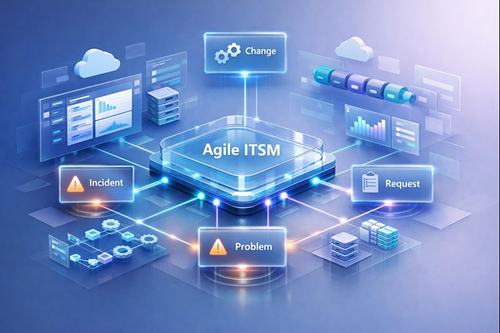
Agile IT Service is the rethinking of IT service management processes based on ITIL (Information Technology Infrastructure Library) by applying Agile principles. The goal is to move away from rigid processes and enable fast feedback loops, continuous improvement, and close collaboration with business teams.
Key Differences Between Traditional and Agile IT Service Management
| Traditional ITSM | Agile ITSM |
|---|---|
| Process-oriented | Value-oriented |
| Rigid approval mechanisms | Fast decision-making |
| Long delivery cycles | Short iterations |
| Resistant to change | Adaptable to change |
Key Benefits of Agile IT Service for Businesses
- Faster service delivery
Increased user and customer satisfaction
Operational efficiency through automation
Flexible adaptation to changing business needs
Scalable and sustainable IT management
These benefits make Agile ITSM a strategic approach—particularly for CIOs, IT Managers, and Service Desk leaders.
How Agile IT Service Management Tools Enable Seamless Integration
The power of Agile ITSM comes from working with different integrations.
The Field Of Agile IT Service Integrations
DevOps tools (Jira, Git, CI/CD pipelines)
Cloud platforms (AWS, Azure, Google Cloud)
Monitoring & APM solutions
CMDB and asset management systems
Enterprise ERP & HR systems
Benefits of Integration
- Reduced manual workload
Automated ticket creation
End-to-end visibility
Faster root cause analysis
Agile ITSM integrations are typically enabled through APIs, webhooks, and pre-built connectors.
How Are Business Processes Optimized with Agile ITSM Platforms?
Agile ITSM platforms optimize not only IT processes, but also business processes as a whole.
Areas Where Optimization Is Achieved
Service request management
Approval processes
SLA (Service Level Agreement) & KPI tracking
Self-service portal usage
Continuous improvement (Continual Improvement)
Contribution of the Agile Approach
Small but rapid improvements
Feedback-driven process design
Close collaboration with business units
As a result, IT moves beyond being a cost center and becomes a strategic business partner.
How Can You Make IT Service Management More Agile?
Adopting an Agile mindset
Applying ITIL processes in a flexible way
Increasing automation and self-service
Tracking progress with measurable metrics
Choosing the right ITSM (IT Service Management) platform
Agile ITSM does not conflict with ITIL; on the contrary, they work stronger together.
How to Choose the Right Service Provider to Digitalize Agile ITSM Processes?
In an Agile ITSM transformation, choosing the right service provider is just as critical as the technology itself.
Key Considerations When Choosing a Service Provider
Expertise in ITIL & Agile
Experience with selected ITSM (IT Service Management) platforms
Integration and automation capabilities
Local and industry-specific references
Continuous support and consulting model
What Are the Most Popular Automation Tools for Agile ITSM?
The success of the Agile IT Service Management approach is not only about defining business processes; it is directly related to the technology platforms that support these processes with automation, integration, and intelligent workflows.
Today, many organizations searching for ITSM (IT Service Management) tools with expectations of speed, flexibility, and digital transformation commonly face the following challenges:
Limited customization and integration capabilities of existing tools
High licensing costs and total cost of ownership
Complexity in adapting processes to the organization’s specific needs
Insufficient AI or automation support
(These concerns are frequently highlighted in industry evaluations.)
When looking at today’s popular Agile ITSM tools, the most suitable Agile IT Service Management platform for an organization is not always the most well-known or widely used solution.
Factors such as process maturity, integration requirements, customization expectations, and total cost of ownershipshould be the key determinants in selecting the right platform.
What Makes SPIDYA ITSM Stand Out?
SPIDYA ITSM is an AI-powered, ITIL-compliant ITSM platform built on a low-code architecture.
This directly addresses the challenges where many traditional ITSM tools struggle:
Smarter and Automated Workflows
AI capabilities of SPIDYA ITSM:
Automatically handles Level 0 (L0) requests, such as password resets or access requests.
AI automatically routes tickets to the right team and resolution path.
Proactively analyzes SLA risks and provides performance insights.
This significantly reduces the manual workload on IT teams while accelerating resolution times.
Flexible and Customizable Low-Code Infrastructure
Thanks to its low-code architecture:
Organizations can quickly adapt or extend processes.
By using only the required components instead of unnecessary modules, cost and complexity are reduced.
This delivers major advantages in terms of speed and efficiency for digital transformation initiatives.
Local Solutions and Superior Support
SPIDYA ITSM is 100% locally developed and designed in compliance with Turkey’s regulatory, compliance, and security requirements.
With on-premises or cloud deployment options, full data control remains within the organization.
A local support network ensures much faster response times.
This is a critical differentiator, especially for public sector, financial services, and other highly regulated industries.
Conclusion: Why Agile ITSM?
Agile IT Service Management is no longer an option for modern organizations—it has become a necessity.
In a rapidly changing business environment, IT teams that lack agility risk losing their competitive advantage.
With the right tools, right integrations, and the right service provider, Agile ITSM enables faster, more efficient, and more sustainable IT service management.