One of the greatest challenges organizations face in their digital transformation journey is integrating new solutions without replacing existing systems. At this point, low-code platform integrations do more than just offer rapid application development; they ensure a sustainable transformation through their ability to integrate seamlessly with the current IT ecosystem.
Today, the success of a low-code platform is measured not only by the speed of development but also by how deeply and effectively it can connect with various systems.
Why Are Low-Code Platform Integrations the Key Metric for Evaluating These Platforms?
Enterprise IT infrastructures generally do not consist of a single system. ITSM tools, monitoring solutions, ERP, and CRM systems often come from different vendors, creating a layered structure over the years.
What Problems Does a Lack of Integration Create?
Data silos are formed.
Processes become dependent on manual intervention.
Incident and request management slow down.
Monitoring data fails to turn into action.
IT teams are overwhelmed by operational workloads.
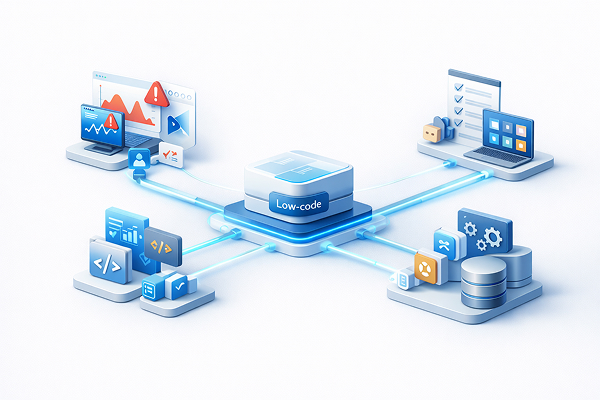
Because of these challenges, low-code platform integrations ensure that these platforms are positioned not merely as “application development tools,” but as a central integration layer.
What are the Integration Options in Low-Code Platforms?
API-Based Integrations (REST & SOAP)
The primary approach for low-code platform integrations is carried out through APIs.
REST API: Lightweight, fast, and compatible with microservices architectures.
SOAP API: Still widely used, particularly in enterprise and legacy systems.
Thanks to this integration type:
Real-time data flow between applications is established.
Automation is built across ITSM, CRM, and business applications.
Workflow automation becomes possible.
Web Service Integrations
Web services ensure that different applications communicate securely. They play a critical role in communication between systems, especially within heterogeneous IT environments. Through low-code platform integrations, these services become manageable via visual components, significantly shortening development timelines.
Database Tabanlı Entegrasyonlar
In certain scenarios, APIs may not be available, or direct access to the data layer is required. This is where database-based low-code platform integrations come into play.
By establishing direct connections with widely used databases such as:
Oracle
PostgreSQL
MS SQL
The following benefits are achieved:
Data synchronization is ensured.
Legacy systems are incorporated into modern processes.
External dependencies are reduced.
Why are ITSM and Monitoring Integrations Critical?
In IT operations, visibility is the prerequisite for taking action. For this reason, ITSM and monitoring connections have become a strategic necessity for low-code platform integrations.
ITSM Integrations
Through integration with ITSM (IT Service Management) tools:
Incident, request, and problem records are created automatically.
SLA (Service Level Agreement) and process tracking become centralized.
User experience is improved.
Low-code platform integrations reduce the operational workload of IT teams by enabling the automation of incident and request management. As an AI-powered modular platform compliant with ITIL (Information Technology Infrastructure Library) standards, SPIDYA ITSM brings these integrations under a centralized structure, ensuring that IT operations are managed with greater control and measurability.
Monitoring Integrations
Connecting data from monitoring systems to business processes:
Accelerates anomaly detection.
Enables proactive action.
Reduces operational risks.
Real-Life Scenario: Turning Integration into Business Value
Despite receiving hundreds of alarms from monitoring tools, many organizations struggle to transform this data into action. An alarm hits the ITSM (IT Service Management) system, requires manual analysis, and the process continues in a fragmented manner.
At this point, low-code platform integrations with high capability can automatically:
Transform monitoring data into an ITSM record.
Route it to the relevant team.
Make the process traceable end-to-end.
This is exactly where low-code platforms make a difference.
Cheetah Low-Code Platform Integration Approach
One of the platforms responding to this integration need is the Cheetah Low-Code Development Platform.
Cheetah aims to provide an integrated experience through a single platform without requiring organizations to replace their existing systems. By leveraging robust low-code platform integrations, it ensures seamless connectivity and operational continuity across the entire IT ecosystem
Supported Integration Structures
REST API & SOAP API
Web service integrations
Database-based integrations
ITSM and Monitoring Tools it Can Work Integrated With
Cheetah possesses out-of-the-box integration capabilities with many widely used solutions:
Jira
ManageEngine
HP Service Manager
Micro Focus
OpenText
Xurrent
Instana
Grafana
Zabbix
SolarWinds
PRTG Network Monitor
This approach transforms low-code platform integrations from project-based development needs into a scalable and sustainable framework.
What Should Be Considered Regarding Integration When Choosing a Low-Code Platform?
When evaluating a low-code platform, the following questions are of critical importance:
Can it integrate with my existing ITSM and monitoring tools?
Does it offer flexibility at the API and database levels?
Are the low-code platform integrations sustainable, or do they require custom development?
How are security and data integrity ensured?
The answers to these questions directly impact the platform’s long-term business value.
Conclusion: Low-Code Platforms Gain Power Through Integration!
In today’s digital world, low-code platforms are positioned not just as rapid development tools, but as a strategic integration layer that brings together an organization’s IT ecosystem.
Platforms that handle API, web service, database, ITSM, and monitoring connections collectively make true digital transformation possible. Solutions with strong low-code platform integrations simplify processes, reduce operational workloads, and deliver measurable value to the organization.